

Moderna Shares Plunge 25% Following Cancer Vaccine Data Leak
Moderna shares plunged up to 25% after trial data for its cancer vaccine leaked ahead of the official release, despite favorable results showing a 42% reduction in the risk of melanoma recurrence or death when combined with Merck's Keytruda.

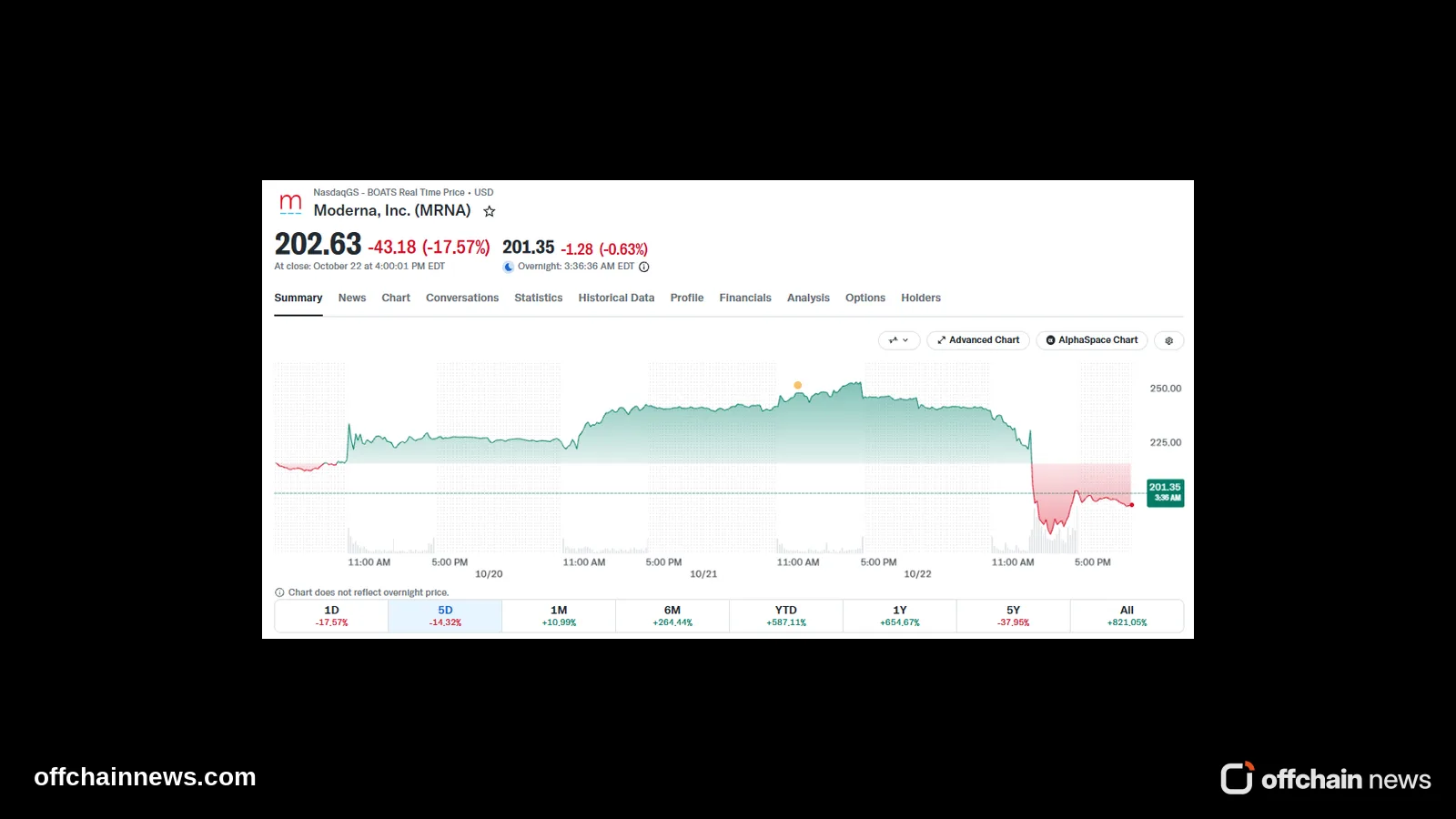
Shares of Moderna slumped as much as 25% on Thursday, October 22, after partial data regarding the Merck and Moderna cancer vaccine leaked on an oncology website prior to its official release. The plunge was unusual because the vaccine actually delivered favorable results, demonstrating a 42% reduction in the risk of melanoma recurrence or death when administered alongside Merck’s Keytruda. By the end of the trading session, the stock price settled at $202.63, marking a decline of $43.18, or 17.57%.
Also Read: Wall Street Raises AMD Stock Target To $620 Ahead Of Earnings
Moderna Stock Drop Follows Cancer Vaccine Data Leak Despite Positive Results
At the time, the downward movement appeared to stem from extremely high expectations colliding with hard figures. Prior to the leak, shares had nearly quadrupled since August, when the two firms announced the trial was successful but withheld specific numbers. While the sell-off erased a substantial portion of those gains, Moderna remained up roughly 587% year-to-date, trading within a 52-week range of $22.28 to $254.48.
What The Merck Moderna Cancer Vaccine Trial Showed
Designated as INTerpath-001, the Phase 3 trial involved 1,137 melanoma patients who had undergone surgery. The vaccine, known as intismeran autogene, analyzes the specific mutations found in an individual patient’s tumor and instructs the immune system to target them.
When combined with Keytruda, the therapy reduced the risk of recurrence or death by 42% and lowered the risk of distant metastasis or death by 38%, compared to Keytruda administered alone. Following a two-year period, 82.2% of patients receiving the combination treatment remained cancer-free, versus 70% in the control group. Furthermore, the benefit increased to a 58% risk reduction after the six-month vaccine regimen concluded. These strong figures on paper made the market’s negative reaction surprising to many observers.
Dr. Dean Y. Li, president of Merck Research Laboratories, stated:
“INTerpath-001 is the first Phase 3 study to demonstrate a clinically meaningful improvement in RFS and DMFS over standard-of-care KEYTRUDA in patients with resected melanoma, setting a new benchmark in the adjuvant setting and representing one of the most significant advances in melanoma treatment since the advent of immunotherapy. These results, building on the body of evidence from the Phase 2b study, strengthen our confidence in the curative potential of intismeran autogene when given in combination with KEYTRUDA. Importantly, these data suggest that, by intervening earlier, this approach may offer a tangible opportunity to change the trajectory of a patient’s cancer.”
Why The Moderna Stock Price Fell Anyway
According to most market analysts, the retreat was driven by sentiment and expectations rather than the underlying science. Prior to the release, multiple Wall Street analysts noted that investors had hoped for a risk reduction of 40% or higher, with many anchoring their outlooks on the earlier Phase 2b study, which had demonstrated a larger impact, as highlighted by RBC Capital Markets. Although the 42% metric cleared that hurdle, it did so by a narrow margin, prompting the slide in Moderna’s stock price alongside a 1.8% drop for Merck. Moderna shifted from a previous close of $245.81 to an intraday low of $180.80, with roughly 49.8 million shares traded—more than double the standard volume of 20.2 million.
Evan Seigerman, an analyst at BMO Capital Markets, attributed the decline to inflated expectations rather than poor efficacy, and representatives at UBS similarly characterized the dataset as robust overall. Conversely, Trung Huynh of RBC maintained a more cautious stance, suggesting that melanoma should have represented the optimal scenario for the treatment.
What Moderna And Merck Plan From Here
Stéphane Bancel, CEO of Moderna, announced that the partners are preparing to submit applications for U.S. approval and anticipate bringing the vaccine to market by 2027. The comprehensive dataset is scheduled for an official presentation on Saturday at the ESMO Congress in Madrid, while the companies are also evaluating the combination regimen for kidney, bladder, and lung cancers. However, this roadmap did little to mitigate the immediate downward pressure on the stock.
Stéphane Bancel, Chief Executive Officer of Moderna, added:
“From the beginning, we believed mRNA technology could make it possible to develop cancer treatments uniquely matched to each patient’s tumor. The INTerpath-001 results mark a defining moment for that vision and show what’s possible when we rethink how medicines are made. These results reinforce our conviction that mRNA has the potential to fundamentally change how we treat cancer.”
Also Read: SpaceX Stock Gets a Shock as Elon Musk Reveals $4.4B Profit
Ultimately, the market reaction reflected the exceptionally high bar set by investors rather than shortcomings in the treatment itself. Market participants who purchased shares near the peak will likely focus closely on upcoming data releases for other oncology indications as well as the upcoming earnings report on November 6, which could trigger further volatility in the share price.
Comments 0 responses