

Is It Time to Sell Micron Stock Despite Record Revenue?
Despite record fiscal 2026 revenue and strong artificial intelligence demand, investors question whether to sell Micron stock amid volatile share prices, slowing NAND price momentum, and shifting market forecasts.


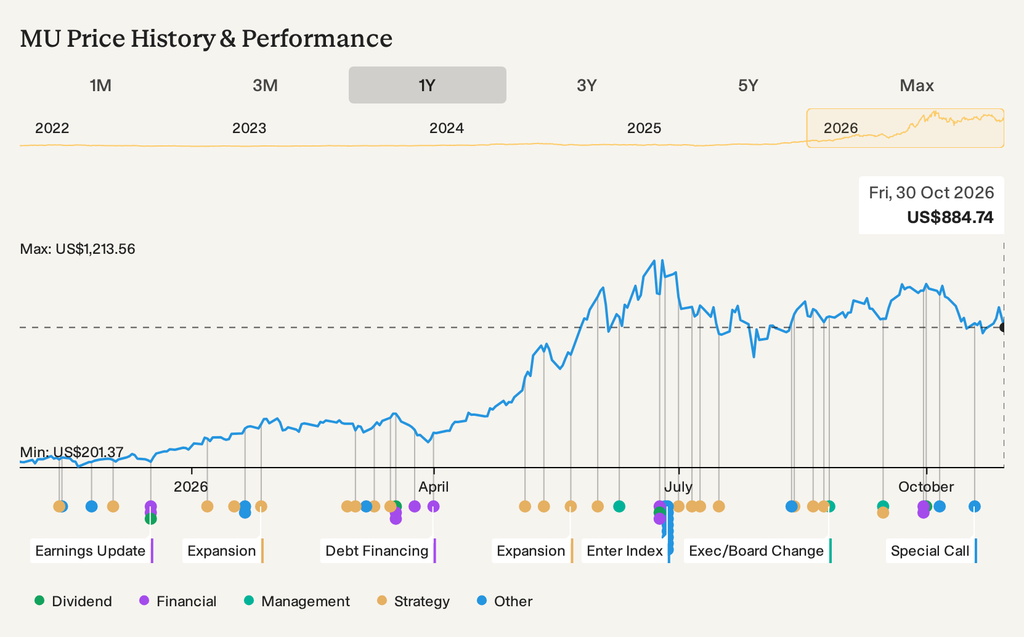
Is it time to sell MU stock? For the majority of long-term investors, the recommendation remains no, at least for the moment. Micron reported a record $54.23 billion in revenue for the fourth quarter of fiscal 2026, alongside projections for constrained memory supply extending through 2028. However, concerns persist regarding Micron NAND prices—following a cautionary note from Kioxia about decelerating price increases—coupled with emerging doubts surrounding artificial intelligence expenditures. Currently, MU stock changes hands at $884.74, and overall analyst projections for Micron remain bullish despite a few cautionary signals.
Also Read: 5 Wall Street Firms Cut Google Stock Price Target After Crash
Micron Stock Outlook: NAND Prices, AI Spending And Earnings
Shares of MU currently trade approximately 27% below their 12-month peak of $1,213.56, while simultaneously registering a gain of roughly 339% from their low point of $201.37. This dramatic volatility is the primary catalyst prompting many shareholders to question whether they should sell MU stock to lock in profits. The visual data below illustrates this entire market trajectory.
Record Micron Earnings And An Even Stronger Outlook
For the entirety of fiscal 2026, Micron generated $133.19 billion in revenue, and management issued guidance estimating roughly $61.5 billion in revenue for the first quarter of fiscal 2027, subject to a $1.5 billion variance in either direction. Furthermore, long-term supply agreements account for over 35% of projected revenue through the year 2030.
Micron Technology Chairman and CEO Sanjay Mehrotra stated:
“Micron delivered record fiscal 2026 results, and we expect an even stronger fiscal 2027. AI is becoming Super Intelligence (SI), and memory enhances this intelligence and the competitiveness of our customers’ platforms. We are increasing our investments in technology, products and manufacturing to help drive SI forward with our customers, and our Strategic Customer Agreements provide added confidence in the durability of Micron’s financial performance.”
These binding agreements serve as the most robust defense for investors wondering if they should liquidate their MU holdings ahead of a potential cyclical downturn.
Micron NAND Prices Slow As AI Spending Gets Tested
Market pressures are currently stemming from industry competitors. While SK Hynix described the memory landscape as tight, Kioxia cautioned that NAND price growth is losing momentum, and Intel pointed out elevated memory expenses. This conflicting set of indicators fuels the ongoing debate over whether to divest from MU.
Any softening in Micron NAND prices would arrive at a delicate juncture, given Micron’s substantial capital expenditure requirements. A broader contraction in AI capital spending, or aggressive price reductions initiated by rivals like SK Hynix, Samsung, or Kioxia, would directly impact that same contractual revenue foundation. Thus far, market speculation has not materially altered Micron’s internal demand projections. Nevertheless, should NAND pricing continue to cool throughout 2027, the rationale for holding MU stock could shift rapidly.
Should I Sell MU Stock? What The Micron Stock Forecast Says
Primary consensus figures monitored by Simply Wall St project Micron to reach $320.4 billion in revenue alongside $217.9 billion in earnings by the year 2029. Based on this perspective, intrinsic value stands roughly 76% above current market valuations. Conversely, more conservative analysts anticipate closer to $236.3 billion in revenue and $207.2 billion in earnings, accompanied by a price-to-earnings ratio near 6x. An alternate fair value assessment among 28 additional estimates points to a potential 38% downside. For anyone debating whether to sell MU stock, this valuation spread remains the critical metric to monitor.
Also Read: Nvidia Stock Falls as Chip Index Sinks 6.8% on AI Spending Fears
Ultimately, should you sell your MU shares? If your investment thesis relies on sustained artificial intelligence demand keeping memory inventories tight, the existing supply agreements and corporate guidance justify maintaining the position. Conversely, if you purchased near the $1,213 peak and find it difficult to stomach another sharp correction, trimming a portion of your holdings represents a reasonable compromise. With the equity trading well below its record highs, upcoming Micron earnings reports and forthcoming NAND pricing data will likely determine which investment perspective proves correct.
Comments 0 responses